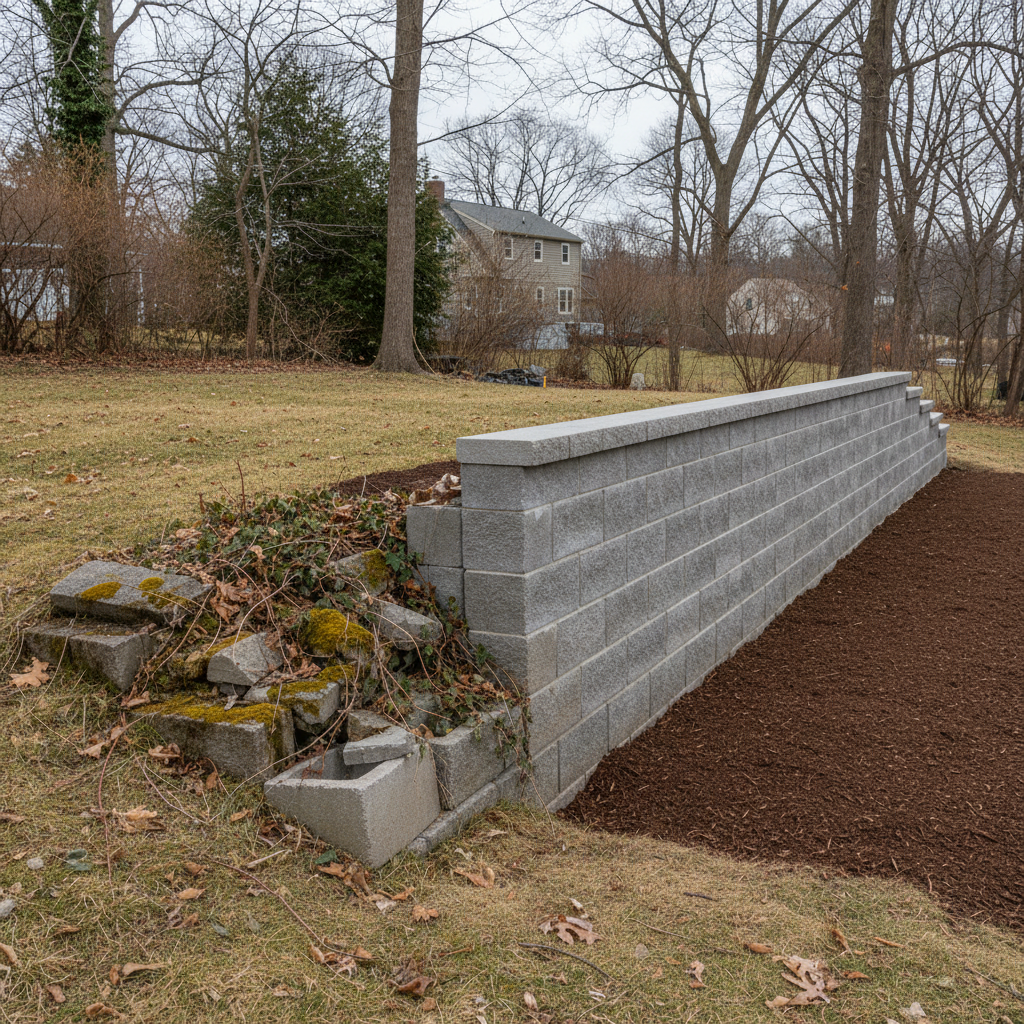
Alright, let's talk walls. Specifically, those big, structural ones you need for a foundation, a basement, or a serious retaining wall. When you're planning a project like that around Newton, you're usually looking at two main contenders: walls built from Concrete Masonry Units (CMU), which are those grey concrete blocks you see everywhere, or walls poured solid with concrete.
Homeowners often ask me, "Which one's better?" And like most things in construction, the answer isn't a simple one-liner. It depends on what you need, what your budget looks like, and what kind of conditions we're dealing with here in Massachusetts. Let's get into it.
Concrete Masonry Units (CMU) Walls: The Block-by-Block Breakdown
CMU walls are built by laying hollow concrete blocks, one by one, with mortar joints in between. Think of it like giant LEGOs, but with a lot more skill involved. Once the wall is up, we often fill the cores of the blocks with rebar and concrete for extra strength, especially for foundations or taller retaining walls.
The Good Stuff About CMU:
- Cost: Generally, CMU walls can be a bit more budget-friendly on the initial build. The materials themselves are usually cheaper than the concrete for a poured wall, and the labor, while skilled, can sometimes be less intensive than setting up complex forms for a pour.
- Flexibility: Because you're working with individual blocks, it's easier to make adjustments on the fly, or to accommodate tricky angles and curves. If you've got an older home in a place like Nonantum with some quirky foundation needs, CMU can adapt well.
- Repair: If a section gets damaged, it's often easier to cut out and replace individual blocks than to repair a large section of poured concrete.
Where CMU Might Not Be Your First Choice:
- Waterproofing: Those mortar joints are potential weak points for water intrusion. While we always apply waterproofing membranes, a CMU wall inherently has more seams than a solid poured wall. You need to be extra diligent with drainage and exterior waterproofing, especially with our wet springs and heavy snowmelt.
- Strength (Relative): While reinforced CMU walls are plenty strong for most applications, a solid, properly reinforced poured concrete wall generally offers superior monolithic strength.
- Appearance: Unless you're going for a specific look, CMU isn't usually considered a finish material. It's often covered with stucco, siding, or drywall.
Poured Concrete Walls: The Solid Option
Poured concrete walls are exactly what they sound like: liquid concrete poured into temporary forms, where it cures into a single, solid piece. This is a common method for modern foundations and basements.
The Good Stuff About Poured Concrete:
- Strength & Durability: This is where poured concrete really shines. You get a single, monolithic structure that's incredibly strong and resistant to lateral forces. It's less prone to shifting or cracking due to soil pressure, which is a big plus with our freeze-thaw cycles here in New England.
- Water Resistance: With fewer joints, a poured concrete wall is inherently more watertight than a CMU wall. When properly waterproofed and drained, it offers excellent protection against basement leaks.
- Faster Construction (Sometimes): Once the forms are set, the concrete can be poured relatively quickly. The curing time is the main factor, but the actual pouring process is fast.
- Appearance: A smooth, unblemished concrete wall can be left exposed if desired, offering a clean, industrial look.
Where Poured Concrete Might Give You Pause:
- Cost: Often, poured concrete walls can be more expensive upfront. The forms themselves are a significant investment, and the concrete volume can add up.
- Flexibility: Once the forms are set and the concrete is poured, there's no going back. Changes or modifications are much harder and more costly.
- Repair: If a poured wall cracks or gets damaged, repairs can be more complex and sometimes more visible than with CMU.
My Recommendation for Newton Homeowners
For most foundation and basement wall applications in Newton, especially for new construction or major additions, I generally lean towards poured concrete walls.
Why? Our climate. We get a lot of rain, a lot of snow, and those constant freeze-thaw cycles put a tremendous amount of stress on foundations. The superior monolithic strength and inherent water resistance of a poured concrete wall just offer a better long-term solution against hydrostatic pressure and moisture intrusion. You'll thank yourself later when you're not dealing with a damp basement.
That's not to say CMU walls are bad. For certain retaining walls, particularly shorter ones, or for interior walls, they can be a perfectly viable and cost-effective option. Ace Masonry Co. builds plenty of both, and we do it right.
But if you're building something that needs to hold back a lot of earth or keep your basement dry for decades to come, the extra investment in a poured concrete wall is usually worth it. It gives you peace of mind, and that's something you can't put a price on.
Ultimately, the best approach depends on your specific project. Give us a call, and we can walk through your plans and figure out the right wall for your home.